01
Invoice number and issue date
Use a clear invoice number and issue date so both you and the client can track the document properly.
A freelance invoice template should clearly show who is being billed, what the client is paying for, how much is due, when payment is expected, and how payment should be made. A clean invoice reduces confusion, speeds up approval, and helps you get paid with less back-and-forth.
At minimum, a freelance invoice should help the client answer four questions quickly: who is billing them, what work is being billed, how much is due, and how to pay. The more obvious those details are, the smoother payment usually becomes.
Use a clear invoice number and issue date so both you and the client can track the document properly.
Include your name or business name, plus the client name and any billing details they need on file.
Make it obvious what the invoice covers, whether that is a deposit, milestone, hourly work, or final payment.
The final total should be easy to spot at a glance, even if there are subtotals, tax, or multiple line items.
Always state when payment is due. Do not assume the client will infer it from the issue date alone.
Tell the client exactly how to pay, including method, account details if needed, and any reference information.
Depending on your situation, you may also need to show tax, currency, purchase order details, or a billing period. The right structure depends on your workflow, but the goal stays the same: the invoice should feel complete, clear, and easy to process.
Here is a simple example of what a clean freelance invoice can look like. The exact wording can vary, but the structure should make the payment request easy to understand.
| Invoice number | INV-2026-014 |
|---|---|
| Issue date | March 16, 2026 |
| Due date | March 30, 2026 |
| From | Jane Smith Studio |
| Bill to | Acme Creative Ltd. |
| Description | Website copywriting project — final payment for homepage, about page, and contact page copy |
| Total due | $1,200 USD |
| Payment terms | Net 14 |
| Payment method | Bank transfer |
Good invoicing usually starts earlier in the workflow. First price the work, then confirm the scope, then send the invoice at the agreed stage — such as upfront, at a milestone, or after delivery.
Payment terms tell the client when payment is expected. The best option depends on your project type, the kind of client you work with, and what was agreed before the invoice was sent.
Payment is expected as soon as the invoice arrives. This is often used for deposits, small projects, or trusted repeat workflows.
Payment is due within 7 days. This keeps the payment window short while still giving the client a little room to process it.
A common middle ground for freelance work. It gives the client time to process payment without letting the invoice drift too long.
More common with larger organizations or procurement-heavy clients. It can be normal, but it slows cash flow if used everywhere.
You can also invoice in stages, such as a deposit upfront, a milestone invoice during the project, and a final invoice on delivery. The key is to match the invoice timing to the agreement already approved by the client.
Many delayed payments happen because the invoice is incomplete, hard to process, or inconsistent with what the client expected.
If the invoice does not clearly say when payment is due, clients often default to their own internal timeline.
Vague descriptions can slow approval and create unnecessary back-and-forth about what is being billed.
If the client has to ask how to pay, the invoice is not doing its job yet.
The invoice should match the agreement: deposit, milestone, or final payment. Bad timing creates avoidable friction.
Invoicing works best when it is part of a cleaner client workflow, not a last-minute admin task.
Start with intentional pricing so your invoice later reflects a clear decision, not a rushed guess.
Use a quote or proposal to align on deliverables, totals, timeline, and when payment is expected.
Send the invoice when the agreement says payment is due, whether that is upfront, at a milestone, or after delivery.
Keep the reminder short and professional. Restate the invoice number, amount due, original due date, and payment method.
Late payment follow-up does not need to be aggressive. Most of the time, a clear and professional reminder is enough to restart the process.
Start with the assumption that the invoice was missed, delayed internally, or forgotten. A short reminder is usually more effective than a long emotional email.
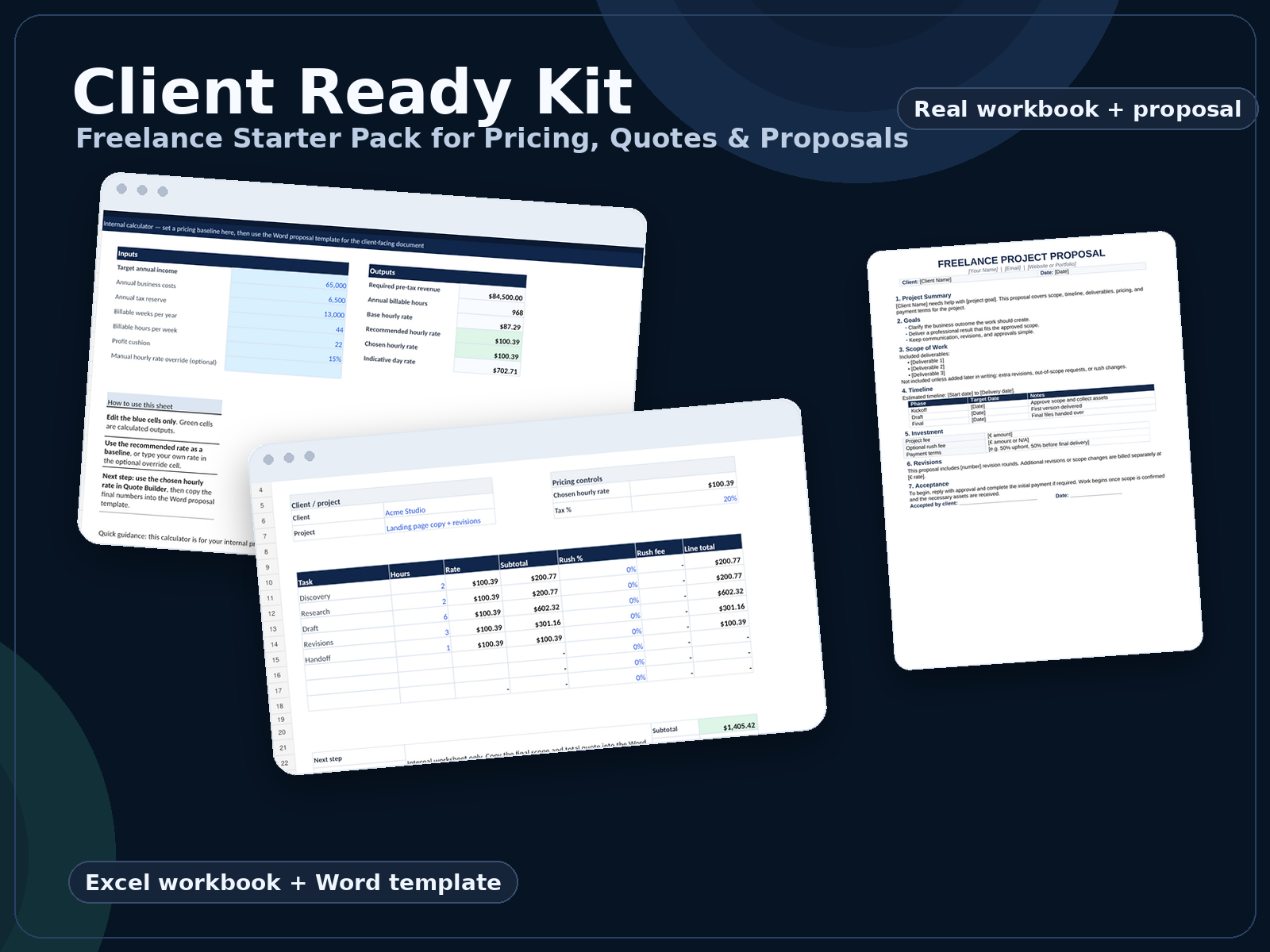
Client Ready Kit includes the reusable workbook for pricing and quotes, plus the invoice and proposal templates to help you run a cleaner freelance workflow from first quote to final payment.
Quick answers around freelance invoices, payment terms, and billing workflow.
A freelance invoice should usually include your business details, client details, invoice number, issue date, due date, services provided, total amount due, and payment instructions.
That depends on the agreement. Some freelancers invoice upfront, some at milestones, and some after delivery. The invoice should match the payment timing already agreed with the client.
Common options include due on receipt, net 7, net 14, and net 30. The right choice depends on your workflow, cash flow needs, and client type.
If tax applies to your work, yes. Just make sure the invoice still makes the final amount due easy to understand.
Yes. Many freelancers do. The important part is that the invoice still looks complete, readable, and easy for the client to process.
Send a short professional reminder that restates the invoice number, amount due, and original due date, then attach the invoice again for convenience.