01
Set a pricing floor
Your rate should cover your income goal, business costs, taxes, and a buffer — not just the hours you hope to work.
A freelance pricing calculator helps you stop guessing what to charge. The goal is not to find one magic number. It is to set a realistic pricing floor, understand your real billable capacity, and turn that logic into project pricing that actually works.
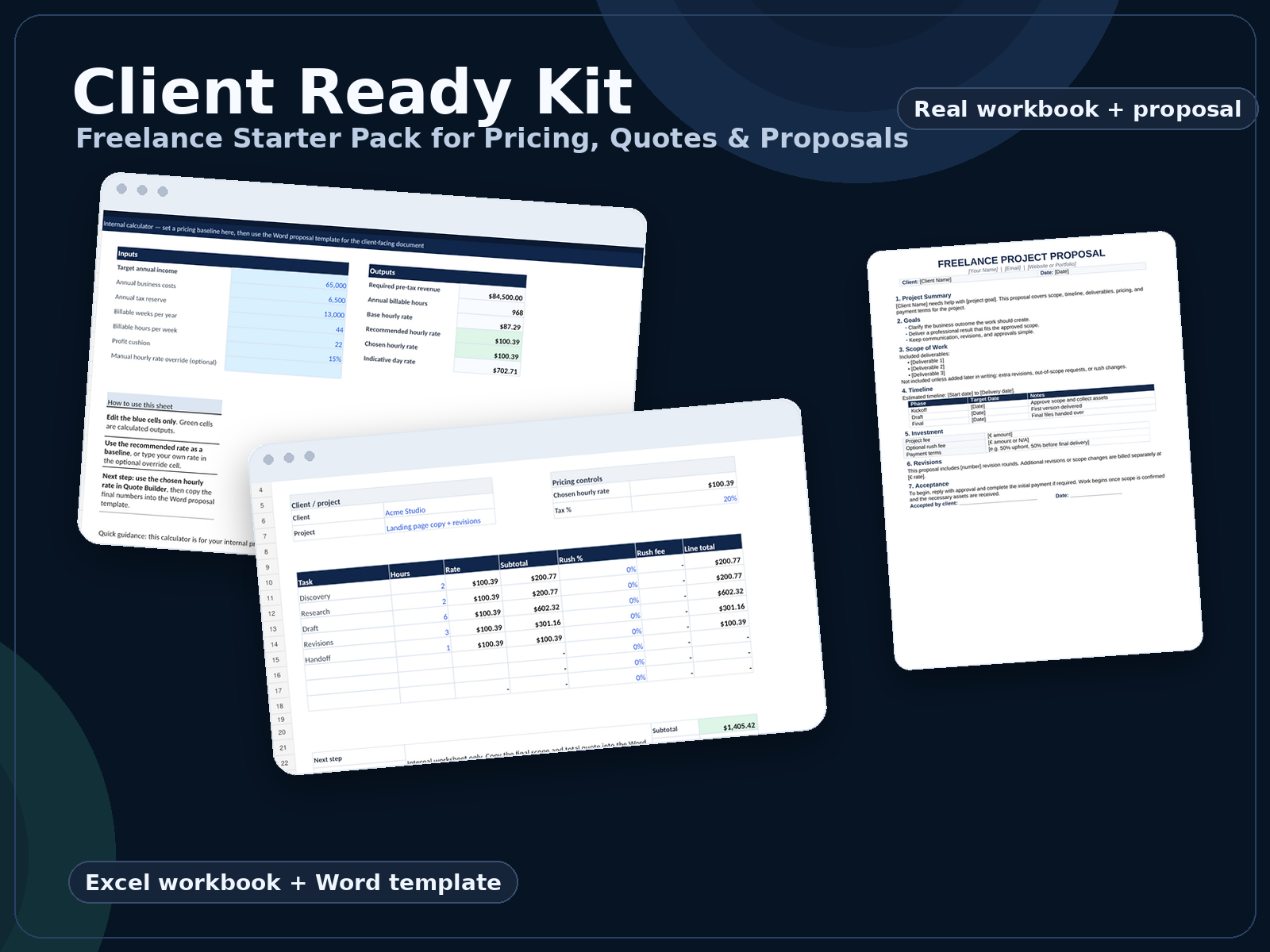
A good pricing calculator is not just about arithmetic. It should help you understand your minimum viable rate, show how many hours you can realistically bill, and give you a pricing baseline before you build quotes or proposals.
Your rate should cover your income goal, business costs, taxes, and a buffer — not just the hours you hope to work.
Freelancers rarely bill every hour they work. Admin, sales, revisions, and communication all reduce true billable capacity.
The calculator is the internal step. The next step is using that logic to build quotes, proposals, and project fees that still make sense.
Here is a simple example of how a freelance pricing baseline can be calculated. The exact numbers will differ, but the logic is what matters.
| Income goal | $70,000 |
|---|---|
| Business costs | $8,000 |
| Tax reserve | $15,000 |
| Cushion | $7,000 |
| Total target revenue | $100,000 |
| Real annual billable hours | 1,000 |
| Baseline hourly rate | $100/hour |
One of the biggest pricing mistakes is assuming total working hours equal total billable hours. In reality, a large part of freelance work is necessary but not directly billable.
If you assume you can bill every working hour, your rate will often come out far too low. Realistic billable hours are one of the most important parts of pricing freelance work properly.
Even if you prefer fixed project fees, the hourly calculation still matters because it helps you understand the pricing floor underneath the final number.
Useful when the scope is flexible, the work is ongoing, or the time required is hard to predict. It is often the clearest internal baseline.
Useful when the scope is clear and the client wants a simpler fixed fee. The project price should still be grounded in real pricing logic, not guesswork.
In practice, many freelancers calculate an hourly baseline internally and then turn that into a fixed project fee that accounts for complexity, scope, revisions, risk, and value.
A baseline hourly rate is only the starting point. Final project pricing often changes based on the actual shape of the work.
More moving parts, more stakeholders, or more specialized work usually justify a higher project fee.
Rush work often creates extra pressure, rescheduling, or opportunity cost, so the final price may need to go up.
Unclear scope, unpredictable revisions, or client-side delays can all increase the pricing risk of a project.
If the project has unusually high value to the client, the price may reasonably move beyond a simple hours-based calculation.
More revision rounds and more stakeholders often increase the real time and coordination involved.
Your final pricing also depends on how you want to position yourself in the market, not just on raw time math alone.
Many freelancers do not undercharge because they are bad at math. They undercharge because they ignore hidden work and price only the visible task.
“This feels like maybe $300” is not a pricing method. A calculator gives you a better starting point before you adjust for complexity or value.
If you work 40 hours per week, that does not mean you can bill 40. Most freelancers lose significant time to admin, calls, revisions, and sales.
Pricing has to cover software, equipment, subscriptions, accounting, taxes, and the unpaid time required to run the business.
The calculator is for internal pricing logic. Clients usually need a cleaner quote, proposal, or invoice instead of the working sheet behind it.
Good pricing is not a single number. It is part of a workflow that connects the internal logic to the client-facing documents.
Start by calculating a recommended baseline based on your annual goals, costs, tax reserve, and realistic billable time.
Factor in complexity, urgency, revision risk, and value before turning the baseline into the final project price.
Turn the chosen pricing into line items, scope, and totals so the client sees a clearer estimate instead of raw pricing math.
Once the price is clear, the rest of the workflow becomes easier: present it cleanly in the proposal and invoice according to the agreement.
Client Ready Kit includes the reusable workbook and proposal template so you can price projects, build quotes, and send cleaner proposals without starting from scratch every time.
Quick answers around freelance pricing calculators and rate setting.
Start with your income goal, business costs, tax reserve, and cushion, then divide that total by your realistic annual billable hours. That gives you a baseline to work from.
It depends on your workflow, but many freelancers have far fewer billable hours than total working hours because admin, sales, revisions, communication, and downtime all reduce billable time.
Not necessarily. A calculator gives you a strong baseline. You may still adjust based on urgency, complexity, scope risk, client value, and how you want to position your services.
Yes. Even if you present fixed project fees, the calculator still helps because it shows your pricing floor and helps you test whether the final number makes sense.
Usually no. The calculator is for internal pricing decisions. Clients usually receive a quote, proposal, or invoice instead of the spreadsheet itself.
Yes. Many freelancers use the calculator as a recommendation, then choose a manual rate or project fee once they account for positioning and project-specific factors.