01
Project summary
Start with a short description of the work so the client immediately knows what the quote covers.
A freelance quote template should help a client quickly understand what work is included, what the project costs, how long it will take, and what happens next. A good quote reduces hesitation, makes the scope easier to trust, and creates a cleaner path toward approval.
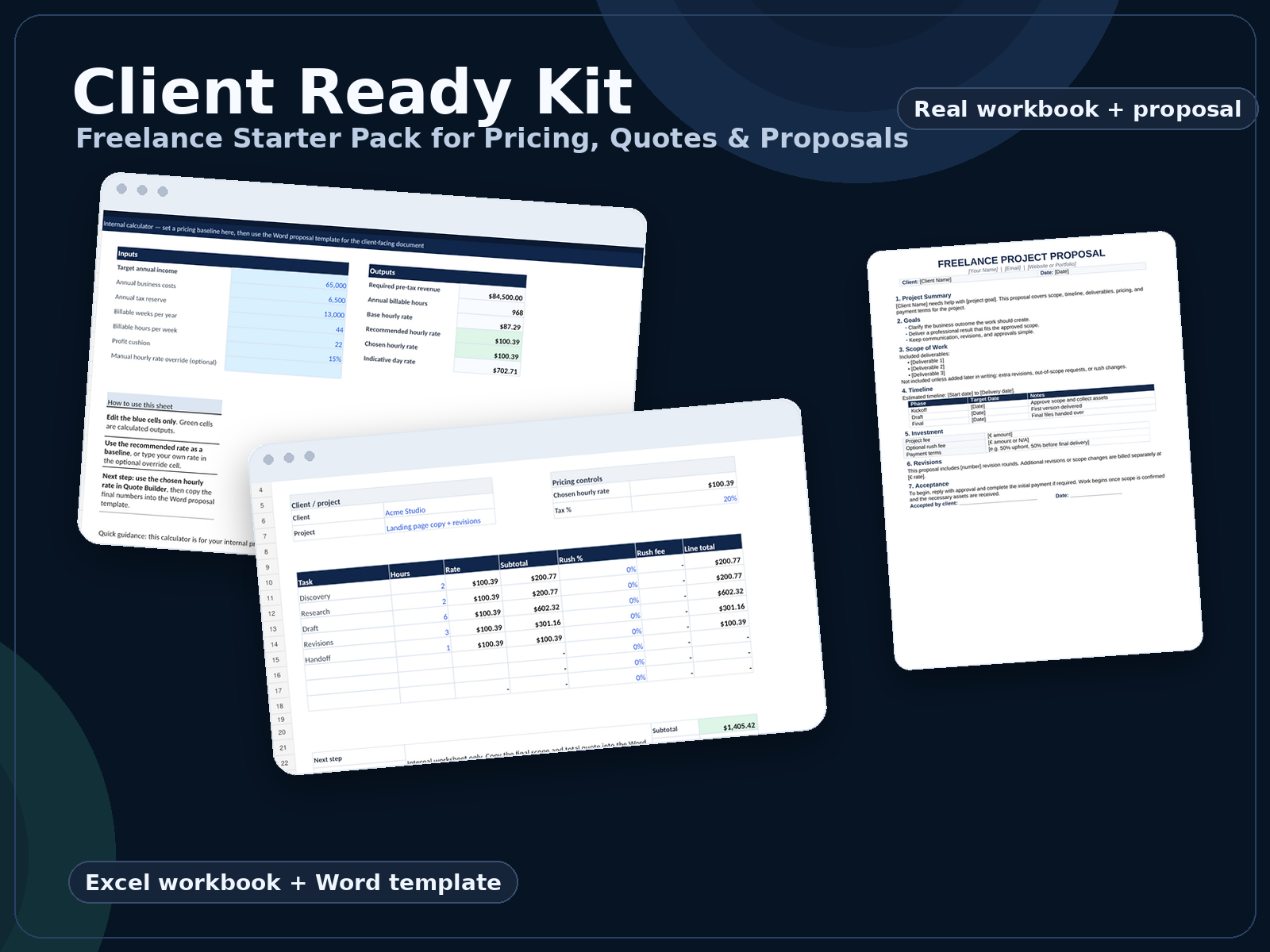
A quote is not your internal worksheet. It is the cleaned client-facing version of your estimate. The goal is to make the project feel understandable, well scoped, and easy to approve without dumping every internal calculation onto the client.
Start with a short description of the work so the client immediately knows what the quote covers.
Break the work into clear deliverables so the quote feels concrete instead of vague.
Show the total clearly and make any subtotals, add-ons, or tax easy to follow.
Give a realistic project timing estimate so the client can picture how the work will move forward.
Make it clear what is included and what would count as extra work, extra pages, or extra revisions.
End with a simple next action so the client knows how to approve and move into the next stage.
Some freelancers also include an expiry date, payment schedule, optional add-ons, or assumptions about client feedback and revisions. The more clearly the document sets expectations, the easier it is to avoid confusion later.
Here is a simple example of what a freelance quote can include. The exact wording may change, but the structure should make the project easy to review and approve.
| Project | Website copy refresh for a small business site |
|---|---|
| Deliverables | Homepage copy, about page copy, contact page copy, 2 rounds of revisions |
| Timeline | 2 weeks from project start |
| Total quote | $1,200 USD |
| Payment schedule | 50% upfront, 50% on final delivery |
| Validity | Quote valid for 14 days |
| Exclusions | Additional pages, strategy workshop, and extra revision rounds are not included |
| Next step | Reply to approve the quote and confirm the project start date |
These terms often get mixed together, but they do not all mean exactly the same thing. Clarifying the difference helps you choose the right document for the stage of the project.
A rough early number. It is useful for quick discussions, but it is usually less detailed and less final than a quote.
A more structured document focused on scope, deliverables, price, and next steps. It gives the client something clearer to review.
A broader client-facing document that often adds more framing, goals, process, timeline, and approval language around the quoted work.
In a simple workflow, the estimate is the rough early number, the quote clarifies the actual scope and price, and the proposal becomes the fuller presentation document if the project needs more structure or persuasion.
Good quotes do more than list a price. They also make it easier to manage expectations by showing how long the quote is valid, what is not included, and which items are optional.
Usually yes. A quote validity period such as 7, 14, or 30 days helps protect you from old pricing being accepted much later after your rates, schedule, or availability have changed.
Exclusions might include extra pages, extra revision rounds, rush delivery, strategy calls, or anything outside the agreed scope. Clear exclusions reduce scope creep later.
Optional add-ons usually work best as separate line items or clearly labeled extras. That lets the client see what is included in the main quote and what costs more.
Often yes. Even if the full payment details later appear in the invoice, the quote can still note whether the project is paid upfront, in stages, or on completion.
Most freelancers price internally first, then turn those numbers into a cleaner quote. That keeps the client-facing document easier to understand and stops the quote from looking like a messy working sheet.
Most quote problems do not come from weak writing. They happen when the structure is unclear, the scope feels loose, or the client does not know how to move forward.
If the client cannot tell what they are paying for, the quote creates uncertainty instead of trust.
A quote should be clear, not bloated. The client does not need every calculation, note, or draft estimate behind the number.
Quotes that do not define what is included make revision creep and scope confusion much more likely.
If the client finishes reading and still does not know how to approve or proceed, the quote is weaker than it should be.
The easiest way to create better quotes is to separate pricing decisions from client presentation.
Start with your rate, hours, deliverables, and project assumptions inside your worksheet or pricing calculator.
Organize the final scope, price, timeline, validity period, and exclusions so the project feels clear before the client sees it.
Some projects only need a quote. Others benefit from a fuller proposal that adds more framing, structure, and approval language.
Once the quote or proposal is accepted, invoice according to the agreed payment timing and keep the workflow consistent.
Client Ready Kit includes the internal pricing and quote workflow plus the client-facing proposal template, so you can build cleaner quotes without starting from scratch every time.
Quick answers around freelance quotes, scope, and client approval.
A freelance quote should usually include a project summary, deliverables, pricing, timeline, scope boundaries, and a clear next step for approval.
A quote usually focuses on scope and price. A proposal often adds more context, goals, timeline, process, and approval language around that quoted work.
Sometimes, but not always. Many freelancers calculate internally using hourly logic, then present a simpler project-based quote to the client.
Usually yes. A quote validity period such as 7, 14, or 30 days helps protect you from old pricing being accepted long after your rates or availability have changed.
That is exactly why it helps to define what is included up front. Anything outside that scope can be quoted separately later as an additional fee or add-on.
Usually no. The workbook is best used internally. Clients should generally see the cleaned quote or proposal version instead of your working sheet.